


Every week customers send us photos of chewed leaves, sticky stems, or mystery specks, usually with the same question: what do I spray? And the honest answer is usually: not yet. Most infestations we see would have been stopped by a hose nozzle and a pair of scissors two weeks earlier, and half the sprays people reach for do not even work on the pest they have. Insecticidal soap does nothing to a caterpillar. Bt does nothing to an aphid.
So this guide works the way we tell our customers to work: identify the pest first, then climb an escalation ladder from the gentlest fix upward, and only bring out a spray when the cheap moves fail. That approach has a name, integrated pest management (IPM), and it is what university extension programs have recommended for decades because it protects the ladybugs and bees doing free pest control in the background.
Step one: identify what you are dealing with
Grab a hand lens or use your phone camera zoomed in, and check leaf undersides first, because that is where most pests hide. Match what you see:

| Pest | What you see | Where it hides | First fix |
|---|---|---|---|
| Aphids | Pinhead-size pear-shaped bugs in clusters, green to black, with two "tailpipe" tubes; sticky honeydew below | New growth, buds, leaf undersides | Hard water blast, repeat every few days |
| Spider mites | Faint stippled or bronzed leaves, fine webbing, moving dots smaller than a period | Leaf undersides, worst in hot, dry, dusty spells | Rinse foliage, raise humidity, insecticidal soap |
| Whiteflies | Tiny white wedges that lift off in a cloud when disturbed; honeydew | Undersides of upper leaves | Yellow sticky cards, soap on undersides |
| Thrips | Silvery streaks and scars with black specks of frass; flowers deformed | Buds, petals, leaf folds | Blue sticky cards, prune damage, spinosad if severe |
| Mealybugs | White cottony tufts at stem joints | Leaf axils, under pot rims | Dab with rubbing alcohol on a swab, then soap |
| Scale | Immobile brown or white bumps that scrape off with a fingernail; sticky leaves | Stems and leaf midribs | Scrape off, then horticultural oil to smother |
| Fungus gnats | Small dark flies rising from potting soil; plants weaken slowly | Damp potting mix (larvae) | Let soil dry 2 inches down, yellow cards, Bti soil drench |
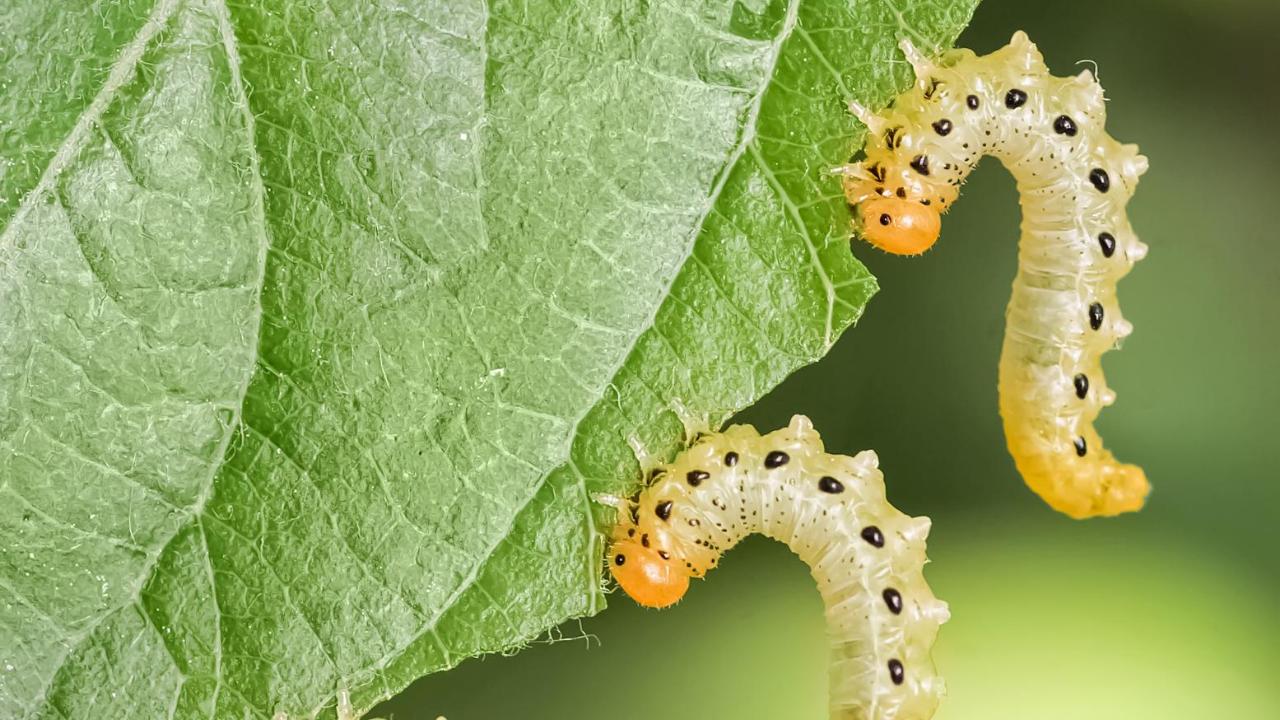
| Caterpillars | Ragged holes, dark droppings, silk, rolled leaves | Leaf undersides, folded leaves | Handpick, then Btk while larvae are small |
| Flea beetles | Dozens of clean round pinholes ("shotgun" leaves) | Seedling brassicas, eggplant, radish | Row cover from transplant day |
| Slugs and snails | Big ragged holes plus silvery slime trails, overnight | Mulch, board undersides, pot rims | Evening handpick, beer traps, iron phosphate bait |
Two clues narrow things fast. Sticky, shiny leaves mean a sap-sucker (aphids, whiteflies, scale, or mealybugs) is feeding above, and the black film that follows is sooty mold growing on their honeydew. Damage with no insect in sight usually means night feeders: go out with a flashlight two hours after dark and you will often catch slugs, earwigs, or caterpillars red-handed.
The escalation ladder
Work these four rungs in order. Most problems never make it past the second.
Rung 1: culture. Healthy, unstressed plants recruit fewer pests, and a surprising amount of "pest control" is really watering and spacing. Overfertilized plants push soft nitrogen-rich growth that aphids find irresistible; drought-stressed plants are spider mite magnets.
Rung 2: physical removal. Hands, water, traps, and barriers. Unfashionable, immediate, and zero collateral damage.
Rung 3: biology. Let predators do the night shift. One ladybug larva eats hundreds of aphids before pupating; hoverfly and lacewing larvae work at similar rates.
Rung 4: least-toxic sprays. Soap, horticultural oil, neem, Btk, spinosad, each matched to the pest and applied at the right hour. Broad-spectrum insecticides sit above this ladder for a reason: they kill the rung 3 workforce along with the pest, and gardens sprayed that way often rebound with worse mite and aphid outbreaks than they started with.
Rung 2 in practice: the physical toolkit

- The water blast. A hard jet from the hose knocks aphids and spider mites off, and most never climb back. Do it in the morning so foliage dries, and repeat every 2 to 3 days for a week.
- Handpicking. For caterpillars, beetles, and slugs, an evening walk with a jar of soapy water outperforms most sprays. Check under leaves and squash any egg clusters you find; every mass is a hundred pests that never hatch.
- Sticky cards. Yellow cards pull in whiteflies, fungus gnats, and winged aphids; blue cards pull thrips. They are as valuable for monitoring as control: a card that fills up in two days tells you to act, one lonely gnat tells you to relax.
- Row covers. Lightweight fabric over hoops, sealed at the soil, simply denies access. This is the single best answer for flea beetles on seedlings and the carrot rust fly. Remove covers when crops flower so pollinators can reach them.
- Slug circuit. Set a board on the soil overnight and scrape off what gathers beneath it each morning. Shallow cups of beer sunk to the rim drown slugs by the dozen, and iron phosphate bait handles bigger populations without endangering pets or birds.
- Pruning. A mealybug colony on one branch tip or a leaf curled around aphids is often best removed entirely, bagged, and trashed.
Rung 3: recruit the predators
The fastest way to more ladybugs, lacewings, hoverflies, and parasitic wasps is not buying them. It is feeding them. Adult beneficials mostly eat nectar and pollen from small, shallow flowers, so a garden with sweet alyssum, dill, yarrow, cilantro gone to flower, and marigolds keeps the workforce resident year-round.
About purchased ladybugs, since customers ask: most sold in bags are convergent lady beetles harvested from wild winter aggregations, and studies find the majority fly away within about 48 hours of release. Save the money and plant flowers instead. And leave small aphid colonies on tough plants like nasturtiums alone entirely; a garden with zero prey cannot hold a predator population, and those sacrificial colonies are what keep your lacewings from leaving.
Rung 4: sprays that work, used correctly
Match the product to the pest, hit the leaf undersides, and spray at dusk when bees are done for the day.
- Insecticidal soap (potassium salts of fatty acids) kills soft-bodied pests (aphids, mites, whiteflies, mealybugs) on contact by dissolving their outer coating. It has no residual effect at all, so coverage is everything and you will need 2 to 3 rounds, 5 to 7 days apart, to catch newly hatched generations. Do not spray in direct sun or above about 90 F, which is when leaf burn happens, and buy a proper insecticidal soap rather than improvising with dish detergent, which strips leaf wax.
- Horticultural oil smothers scale, mite eggs, and overwintering insects; it reaches life stages soap misses.
- Neem oil (azadirachtin) works slowly as an antifeedant and growth disruptor: pests that eat treated foliage stop feeding and fail to molt. Expect results over a week or two, not overnight. Same rules: dusk application, not in heat, never on drought-stressed plants.
- Btk (Bacillus thuringiensis kurstaki) is a bacterium lethal only to caterpillars that eat sprayed leaves. Harmless to bees, birds, and you; useless against everything that is not a caterpillar. Apply while larvae are small and reapply after rain, since sunlight breaks it down within days.
- Bti granules or dunks in the watering can control fungus gnat larvae in houseplant soil.
- Spinosad covers the hard cases (thrips, leafminers, beetle larvae) but is toxic to bees while wet, so it is a dusk-only, blooms-avoided, last-resort tool in our book.
One honest note about older advice, including the previous version of this very article: botanical insecticides like rotenone and nicotine sulfate still circulate in old gardening guides, and both have been pulled from US home-garden use over safety concerns. If a recommendation is old enough to include them, verify the rest of it too.
For DIY spray mixing, use our tested recipes in the homemade garden pest repellent guide rather than eyeballing ratios; too-strong soap and pepper mixes damage leaves faster than most pests do.
Companion planting: what actually holds up
Companion planting attracts big claims, so here is the version supported by research and our own beds.
French marigolds genuinely suppress root-knot nematodes. Their roots release alpha-terthienyl, a compound toxic to these microscopic root parasites, but the effect requires a dense planting grown for a full season and turned into the soil, not one lonely marigold on patrol. The flowers also feed hoverflies, whose larvae are serious aphid predators. We grow Crackerjack marigolds as a working border for exactly these two jobs; one packet plants a border dense enough to matter.
Aromatic herbs interfere with host-finding. Many pests locate crops by scent, and strong-smelling interplantings of basil, rosemary, mint, and dill muddy that signal. Field results vary, but interplanted Genovese basil among tomatoes costs nothing, feeds pollinators in flower, and several trials report fewer thrips and hornworms on basil-interplanted tomatoes. Worst case, you get pesto.
What companion planting will not do is stop an active infestation. A marigold ring around aphid-covered kale changes nothing this season. Think of it as rung 1 and rung 3 infrastructure: planted in spring, paying off all summer. For the full method, including trap cropping with nasturtiums, see our guide to natural pest control for plants.

The houseplant protocol
Indoor pests (mealybugs, spider mites, fungus gnats, scale) play by slightly different rules since there are no predators indoors. Isolate the infested plant in another room, shower the whole plant in the sink or tub, then run three rounds of insecticidal soap a week apart. For fungus gnats, let the top 2 inches of soil dry between waterings and drench with Bti; the larvae live in constantly damp mix, and the moisture change alone breaks the cycle. Quarantine every new plant for two weeks before it joins the collection. Most houseplant outbreaks trace back to one new arrival.
The five-minute weekly scout
Prevention compresses into one habit: walk the garden once or twice a week with coffee in hand and flip leaves as you go. Check new growth for aphids, undersides for stippling and eggs, soil line for slime trails. Everything on the escalation ladder works ten times better against ten pests than ten thousand, and gardens scouted weekly almost never need rung 4 at all.

While you scout, keep expectations calibrated: a working organic garden always has some insect damage, and healthy vegetables shrug off around ten percent leaf loss with no measurable hit to harvest. The goal is not a garden with no bugs. It is a garden where the bugs eating your plants are outnumbered by the bugs eating them.
Sources: Clemson University Home & Garden Information Center, "Insecticidal Soaps for Garden Pest Control"; University of California Statewide IPM Program, Pest Notes: "Aphids."


