



When you're staring at a wall of seed packets, the terms "heirloom" and "hybrid" can feel like a puzzle. But the difference is actually pretty straightforward, and it all comes down to genetics, history, and how the seeds came to be. Getting a handle on this is the first step to picking the right seeds for what you want to achieve in your garden.
The core distinction is this: Heirloom seeds are like family treasures, passed down through generations, that grow plants just like their parents. On the other hand, hybrid seeds are the first-generation kids of two very different parent plants that were intentionally crossed to create something new, often combining the best traits of both.
The Core Difference: Heritage vs. Hybrid Vigor
So, what does this actually mean for the plants in your garden? Let's break down exactly what makes an heirloom an heirloom and a hybrid a hybrid.
What Are Heirloom Seeds?
Heirloom seeds come from open-pollinated plant varieties that have been around for a long, long time—the general rule of thumb is at least 50 years. "Open-pollinated" simply means they are pollinated naturally by insects, birds, wind, or even a gentle shake from a human hand.
Because of this natural, stable process, heirlooms are known as "true-to-type." This is the magic of heirlooms: the seeds you save from your favorite Brandywine tomato will grow more Brandywine tomatoes next year, with the same incredible flavor, shape, and color. They carry a rich history, which you can read more about in our guide on what are heirloom seeds.
What Are Hybrid Seeds?
Hybrid seeds, often marked with an "F1" on the packet (for first filial generation), are the result of a very deliberate, controlled process. Plant breeders carefully cross-pollinate two different parent varieties, each chosen for specific, desirable traits.
The idea is to create an offspring that gets the best of both worlds—a phenomenon called "hybrid vigor." For example, a breeder might cross a tomato that has amazing flavor but gets sick easily with another that's incredibly disease-resistant. The resulting F1 hybrid is often more productive, uniform, and robust than either of its parents.
The most important thing to remember is this: while you can save seeds from an heirloom plant and get the same thing next year, seeds saved from a hybrid will not grow true-to-type. Their offspring will be a genetic lottery, usually reverting to the traits of one of the grandparents, and you'll lose that special combination the breeder worked to create.
For a quick and easy comparison, this table breaks down the fundamental differences at a glance.
Heirloom vs Hybrid Seeds At a Glance
| Attribute | Heirloom Seeds | Hybrid Seeds |
|---|---|---|
| Pollination | Open-pollinated (natural) | Cross-pollinated (controlled) |
| Seed Saving | Seeds produce true-to-type plants | Seeds are unstable and not reliable for saving |
| Genetic Diversity | High, preserving unique traits | Low, bred for specific uniform traits |
| History | At least 50 years old, often with a story | Modern creations, bred for performance |
| Flavor Profile | Known for unique and complex flavors | Often bred for durability and yield |
| Uniformity | Plants and fruits can vary in size and shape | Highly uniform plants and harvest |
Ultimately, choosing between them depends entirely on your gardening goals. Do you want to preserve history and save your own seeds, or are you looking for a predictable, high-yield crop?
Deconstructing Seed Genetics and Generational Stability
To really get to the heart of the heirloom versus hybrid debate, we have to look under the hood at their genetic blueprints. The core difference is all about how traits are passed down through generations, which is the deciding factor in whether you can save your seeds for next year.
Heirloom seeds come from open pollination. This is nature’s way of doing things—pollination happens naturally via wind, insects, or birds. After decades of this process, specific traits lock in and become genetically stable. In simple terms, the plant will reliably produce seeds that grow into plants just like the parent.
This stability is what makes heirlooms so special; they're like living history in your garden. When you save a seed from a Cherokee Purple tomato, you can be confident that next year you'll grow another Cherokee Purple with that same rich, smoky flavor and dusky color. This is how we preserve agricultural biodiversity.
The Power and Limits of Hybrid Vigor
Hybrid seeds are a different story entirely. They are the first-generation offspring, known as F1 hybrids, created by intentionally cross-pollinating two different, very distinct parent plants. Breeders hand-pick the parents to combine specific, desirable qualities—maybe one has fantastic disease resistance and the other produces an enormous yield.
The result is a phenomenon called hybrid vigor, or heterosis. The F1 generation often grows bigger, stronger, and more productive than either of its parents. This is why hybrids are so prized for their reliability and uniform harvests. You can get into the nitty-gritty of this process in our guide on the differences between open-pollinated vs hybrid seeds.
Think of it like this: an F1 hybrid is like a star athlete whose parents were a world-class sprinter and a champion weightlifter. The child inherits the best of both worlds—speed and strength—creating a formidable combination.
But here’s the catch: this supercharged genetic advantage is a one-hit-wonder. It only lasts for a single generation.
Why You Cannot Save Hybrid Seeds
If you try to save seeds from an F1 hybrid plant, you're collecting what will become the F2 generation. The results are almost always unpredictable and disappointing. The carefully combined genes that made the F1 plant so great will separate and shuffle themselves randomly in the next generation.
This means your F2 plants will be a mixed bag, lacking the uniformity and desirable traits of their hybrid parent. It's a genetic lottery. The plants that sprout will often revert to the less-desirable traits of one of the original grandparent plants, and you'll almost never see that perfect F1 balance again. For this very reason, gardeners who depend on the consistent performance of hybrids need to buy fresh seeds every single year.
Evaluating the 3 Dimensions of Flavor, Color, and Variety
For so many of us who garden, the real reward is sensory. It’s the explosion of taste from a sun-warmed tomato, the brilliant colors tossed in a summer salad, and the delightful surprise of weird and wonderful shapes in your harvest basket. When it comes to this experience, heirloom seeds are in a class of their own.
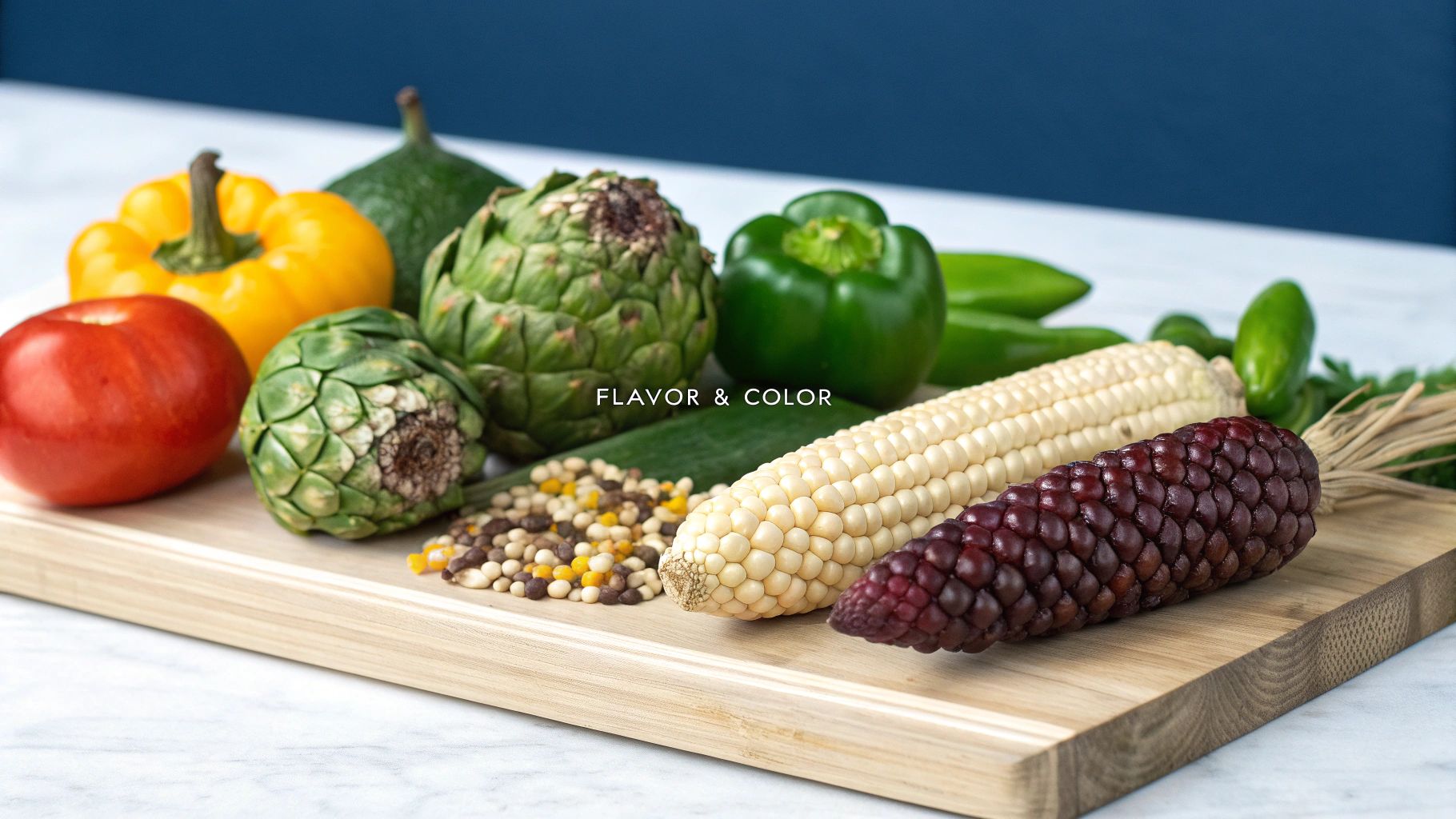
Let's be direct: heirlooms are the undisputed champions of flavor. Their lineage has been protected and passed down precisely because they tasted amazing, not because they could survive a cross-country truck ride. This is why you get the deep, smoky complexity of a ‘Black Krim’ tomato or the perfectly balanced, low-acid sweetness of a ‘Brandywine’. These are flavors with a history.
Hybrids, on the other hand, are often bred with practicality in mind. Commercial growers need plants that produce uniformly sized fruit, have tough skins for shipping, and can sit on a grocery store shelf for a while. These are all valuable traits for the food industry, but they can sometimes mute the incredible flavor genetics that make produce special.
The Heirloom Advantage in the Kitchen
There’s a reason top chefs and serious foodies hunt down heirloom vegetables. They bring a level of culinary excitement to the table that you just don't get from a standard supermarket variety.
- Complex Flavor Profiles: Heirlooms deliver a symphony of taste. You’ll find that perfect balance of acid and sugar, along with subtle notes—earthy, fruity, or even a little spicy—that have been bred out of many modern plants.
- Unique Textures: Think about the difference between a mealy, watery tomato and the dense, creamy flesh of a ‘Cherokee Purple’. Or the satisfying snap of a ‘Dragon Tongue’ bean. Heirlooms offer a whole new world of textures.
- Stunning Visual Appeal: Planting heirlooms is like painting with a full palette. Imagine the dazzling, translucent kernels of ‘Glass Gem’ corn or the vibrant, candy-striped rings of a ‘Chioggia’ beet. They turn a simple harvest into a work of art.
The core trade-off often boils down to this: Hybrids are bred for resilience and uniformity, while heirlooms are preserved for their story and sensory appeal. If an unforgettable meal is your top priority, heirlooms are the clear winner.
A Balanced View on Modern Hybrids
Now, it would be unfair to say that all hybrids are bland. That’s simply not true anymore. Plant breeders have worked hard to create modern hybrids that deliver fantastic flavor right alongside their more practical benefits.
The ‘Sun Gold’ cherry tomato is a perfect example. It's a hybrid, yet it's famous for an intense, tropical sweetness that makes it a favorite for gardeners everywhere.
Ultimately, the difference is one of consistency versus adventure. Many modern hybrids offer a reliable and often delicious flavor. Heirlooms, however, connect you to a rich history, offering a diverse, sometimes surprising, and always rewarding experience for your taste buds. If you’re aiming to grow something truly special, heirloom seeds are still the best way to go.
When it comes down to getting the most food out of your garden with the least amount of trouble, the differences between heirloom and hybrid seeds really start to show. If your main goal is a big, reliable harvest, this is where hybrids often pull ahead. It’s all about intentional breeding.
Hybrids benefit from a phenomenon known as hybrid vigor, or heterosis. Think of it as the best of both worlds, genetically speaking. This advantage gives them a real leg up, translating into higher yields—more tomatoes per plant, more beans per vine—and a crop that ripens more or less at the same time. They are the dependable workhorses you can count on.
The Hybrid Advantage in Tough Conditions
Beyond just sheer volume, hybrids are built to last. Breeders specifically cross-pollinate parent plants to pass on strong resistance to common, crop-wiping diseases. Ever see letters like 'V,' 'F,' 'N,' or 'T' on a seed packet? Those are codes for built-in resistance to nasty stuff like Verticillium wilt, Fusarium wilt, nematodes, or tobacco mosaic virus.
This built-in armor makes hybrids a fantastic choice if you're new to gardening and still learning what to look out for, or if you live somewhere with heavy pest and disease pressure. Their natural vigor also means they can often bounce back better from a surprise cold snap, a missed watering, or other garden curveballs.
If you want a garden that's more about harvesting and less about troubleshooting, the disease resistance and predictability of hybrids offer a great safety net. They are bred for success right out of the gate.
The numbers back this up. The global seeds market, which hit USD 72.62 billion in 2023, is expected to grow to USD 108.94 billion by 2031, with high-performing hybrids leading the charge. In 2023, an estimated 220 million hectares were planted with hybrid seeds, which can produce 20-30% more than open-pollinated varieties. That's a massive difference, especially for staple crops. You can dig into these trends with an in-depth seed market analysis on marketsandata.com.
Where Heirlooms Get Their Grit
Now, this doesn't mean heirlooms are delicate flowers. While they generally aren't known for the broad, lab-tested disease resistance of a hybrid, they have a different kind of strength—one developed over generations.
Heirlooms are survivors. They’ve adapted to thrive in very specific places. This gives them a specialized resilience against local pests, soil quirks, and weather patterns. A hybrid is bred to perform reasonably well almost anywhere; an heirloom might be perfectly dialed in for your specific backyard.
An heirloom tomato that’s been grown in a hot, dry valley for 100 years might have incredible drought tolerance that a hybrid just can't match. This makes them a phenomenal choice for gardeners who want to find a plant that is already a master of their local environment. So, the heirloom vs hybrid seeds debate often boils down to this: do you want the predictable, all-around resilience of a hybrid, or the specialized, localized toughness of an heirloom?
Comparing Costs, Seed Saving, and Garden Sustainability
When you're weighing your options, the conversation about heirloom vs. hybrid seeds goes far beyond what happens in a single season. It's really a question of your long-term goals, your budget, and the kind of relationship you want to have with your garden. Sure, you might notice that a packet of hybrid seeds costs a bit more upfront, but the real financial story plays out over years, not just one spring.
Think of buying heirloom seeds as a one-time investment with compounding returns. Their superpower is their genetic stability, which is what allows you to save your own seeds. Suddenly, you're not just a gardener; you're a steward of your own food source, creating a self-sustaining cycle right in your backyard.
The Power of Seed Saving with Heirlooms
Seed saving is where the magic really happens for a sustainable garden. When you select seeds from your strongest, tastiest heirloom plants, you're doing more than just getting freebies for next season. You're becoming a keeper of agricultural history and biodiversity, with each seed holding a story.
This tradition is more important now than ever. If you're serious about saving seeds for the long haul, proper storage is non-negotiable to keep them viable. For larger collections, some people even use dedicated spaces like small farm sheds for effective storage to keep moisture and pests at bay. To get the basics down, our guide on how to store seeds long term is the perfect place to start.
Heirloom seeds offer true garden independence. By saving seeds, you break the cycle of annual purchases, reduce waste, and cultivate varieties that are uniquely adapted to your specific garden environment over time.
This is a world away from the hybrid seed experience. Since F1 hybrids are genetically unstable in the next generation, saving their seeds is a gamble—they won't grow "true-to-type." To get that same predictable performance, you have to buy new seeds every single year, locking you into a cycle of dependency.
The Hybrid Model and Market Growth
The convenience and predictability of hybrids come with a trade-off: you lose that self-sufficiency. This annual purchasing cycle is what fuels the massive commercial seed market. Just look at India, where hybrid vegetable production shot up from 88.6 million metric tons in 2002 to 178.2 million by 2017, largely because farmers needed crops that could handle a changing climate.
Tomatoes are a classic case. Hybrid varieties have an incredible 99.32% seed replacement rate. Why? Because the plants grown from their saved seeds just don't have the same vigor, the complete opposite of heirlooms that stay consistent for generations. It really frames your choice: are you after the annual convenience of hybrids or the long-term resilience that comes with heirlooms?
Long-Term Value Comparison
To put it in perspective, let's look at how the costs and benefits stack up over a 5-year period for a typical home garden.
| Factor | Heirloom Seeds | Hybrid Seeds |
|---|---|---|
| Initial Cost | Lower initial cost per packet on average. | Often higher due to R&D and breeding costs. |
| Recurring Costs | One-time purchase. Can be saved year after year, reducing costs to $0. | Must be repurchased annually to maintain desired traits. |
| Seed Viability | Saved seeds remain viable for years with proper storage. | F2 generation seeds are not true-to-type; new purchase needed. |
| Adaptability | Plants adapt to your specific soil and climate over generations. | Traits are fixed; no local adaptation occurs. |
| 5-Year Cost | Cost of one packet of seeds, plus minimal storage supplies. | Cost of five packets of seeds (one per year). |
This table clearly shows the financial and sustainable advantage of heirloom seeds over time. While hybrids offer specific solutions for a single season, heirlooms build a foundation for a self-reliant and cost-effective garden for years to come.
How to Choose: A 7-Step Guide for Every Gardener
Alright, we've broken down the "what" behind heirloom and hybrid seeds. Now for the fun part: putting that knowledge to work in your own garden. The truth is, the "best" seed doesn't exist—it all comes down to what you want to achieve.
Let's walk through seven common garden situations to see which seed type makes the most sense for you.
1. The New Gardener Who Just Wants a Win
If you're just starting out, your biggest goal is to actually harvest something. You need a win to build your confidence and keep you coming back next season. For that reason, hybrid seeds are your best friend.
Think of their built-in disease resistance as a safety net. It gives you a buffer against the common pitfalls that can trip up a first-time gardener. Hybrids are also bred for vigor and uniformity, meaning you'll get a predictable, healthy-looking crop, which is exactly the kind of positive reinforcement you need in year one.
2. The Foodie Chasing Unforgettable Flavor
Is your garden basically an extension of your kitchen? Are you growing things because you're obsessed with taste, texture, and unique culinary ingredients? If so, the choice is simple: it has to be heirloom seeds.
Heirlooms are the keepers of flavor history. They were saved for generations for one primary reason—they tasted incredible. You get a depth and nuance you just won't find in most modern varieties, from the smoky, complex taste of a ‘Black Krim’ tomato to the perfume-like sweetness of a ‘Moon and Stars’ watermelon.
3. The Urban Gardener with No Space to Spare
When every square inch of your balcony or patio is prime real estate, you need plants that know how to perform in tight quarters. This is where hybrids specifically bred for container gardening truly shine.
Breeders have put a lot of work into developing compact, bushy varieties that don't sprawl all over the place. These plants are little powerhouses, engineered to produce a fantastic yield in pots and raised beds. They give you a full-size harvest from a pint-sized plant, making them a game-changer for urban growers.
The key difference is intent. Hybrids are often bred to solve specific problems, like limited space, making them a practical solution for modern gardening. Heirlooms, while incredible, generally expect a bit more room to stretch their legs.
4. The Homesteader Focused on Self-Reliance
For anyone aiming for a self-sufficient lifestyle, buying seeds every single year just doesn't make sense. The ability to save your own is everything. This makes heirloom seeds the only practical choice.
Because they are open-pollinated, their seeds will produce plants that are just like the parent. Saving seeds from your best-performing plants isn't just about saving money; over time, you're actually developing your own unique strain that is perfectly adapted to your specific soil and microclimate.
5. The Community Gardener Needing a Reliable Harvest
In a community garden, success is a team sport. You've got multiple people relying on a shared space to produce a consistent amount of food. In this scenario, hybrid seeds are the most dependable players.
Their uniform growth and ripening times make planning and sharing much easier. More importantly, their strong disease resistance helps protect the entire plot from a widespread failure, ensuring everyone who put in the work gets to enjoy a rewarding harvest.
6. The Seed Saver on a Mission to Preserve History
If you see your garden as a living museum and yourself as a steward of history, then heirloom seeds are your calling. By growing and saving them, you're doing more than just gardening—you're an active participant in conservation.
Every heirloom seed carries a fragile genetic story, a piece of our agricultural heritage at risk of being lost forever. Choosing to cultivate these varieties is a powerful act that keeps their unique traits and flavors alive for the next generation of gardeners.
7. The Curious Gardener Who Wants It All
Who says you have to pick a side? For the gardener who loves to tinker, learn, and try new things, planting a mix of both heirloom and hybrid seeds is the ultimate strategy.
Go ahead and plant a few reliable hybrid tomatoes to guarantee you'll have enough for your famous salsa. Right next to them, grow a funky, purple-striped heirloom just to see what it's all about. This approach gives you the best of both worlds: the steady production of hybrids and the thrilling adventure that only heirlooms can offer.
Frequently Asked Questions About Heirloom and Hybrid Seeds
Even after weighing the pros and cons, a few nagging questions always seem to come up when you're standing there, seed packets in hand. Let's tackle three of the most common ones to help you feel confident about your choices.
Are Hybrid Seeds the Same as GMOs?
This is probably the biggest point of confusion out there, and it’s a critical one to clear up. The short answer is no: hybrid seeds are absolutely not the same as GMOs.
Think of it this way: hybridization is an old-school technique that mimics and guides nature. It’s what happens when a gardener or plant breeder intentionally cross-pollinates two different parent plants of the same species. It's like taking the pollen from a ‘Brandywine’ tomato and dusting it onto the flower of a ‘Roma’ to create a new variety. It’s a completely natural, albeit controlled, process.
Genetically Modified Organisms (GMOs), on the other hand, are created in a laboratory. This involves high-tech genetic engineering, like gene splicing, to alter a plant's DNA in ways that could never happen on their own in a field or garden—sometimes even inserting genes from entirely different species.
The bottom line is that hybrids are the result of controlled, conventional breeding, while GMOs are a product of direct genetic engineering. The seeds available to home gardeners are overwhelmingly non-GMO.
This decision tree gives you a simple way to pick seeds based on what you want out of your garden.
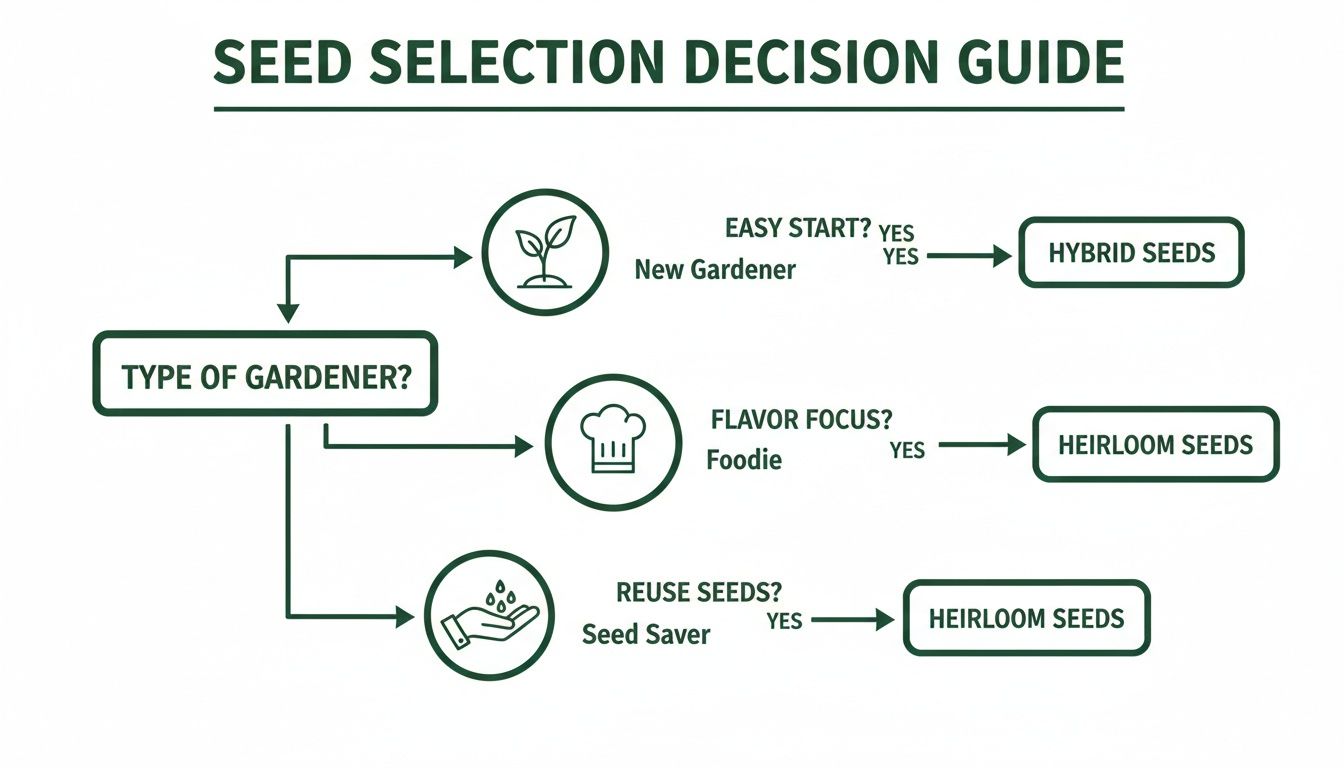
As you can see, your own goals—whether you’re just starting out, chasing incredible flavor, or trying to be more self-sufficient—are really the best guide.
Can I Create My Own Hybrid Seeds at Home?
Absolutely! If you're the experimenting type, creating your own hybrid is a fascinating project. It takes a bit of patience and a steady hand, but it’s a really rewarding process.
Essentially, you just need to play matchmaker. Here’s the basic idea:
- Select Parent Plants: Pick two different open-pollinated varieties. Find one that has a trait you love (like disease resistance) and another with a different trait you want (like amazing flavor).
- Cross-Pollinate: You’ll need to carefully transfer the pollen from one parent flower to the stigma of the other, making sure no stray pollen from insects or the wind gets in there first.
The seeds produced by that hand-pollinated fruit will be your very own, unique F1 hybrid.
What Does Open-Pollinated Really Mean?
You'll see the term open-pollinated a lot, and it's simpler than it sounds. It just means the plant is pollinated naturally—by insects, birds, wind, or other natural means.
All heirlooms are open-pollinated, but not every open-pollinated variety is an heirloom (some are just modern, stable varieties). The crucial thing to remember is that open-pollinated plants have stable genetics. This means their seeds will grow "true-to-type," producing plants that are just like the parent.
Ready to put this knowledge to work? Explore the curated collection of high-quality seeds at Homegrown Garden and find everything from treasured heirlooms to powerhouse hybrids. Find your perfect match at https://www.homegrown-garden.com.


