



If you want to grow pole beans successfully, the recipe is simple: give them plenty of sunshine, soil that's packed with nutrients, and something sturdy to climb. Unlike their bushier cousins, pole beans are the gift that keeps on giving, producing a steady harvest for weeks from just one planting. This makes them a brilliant choice for getting the most out of every square inch of your garden.
Your Guide to a Vertical Bean Harvest
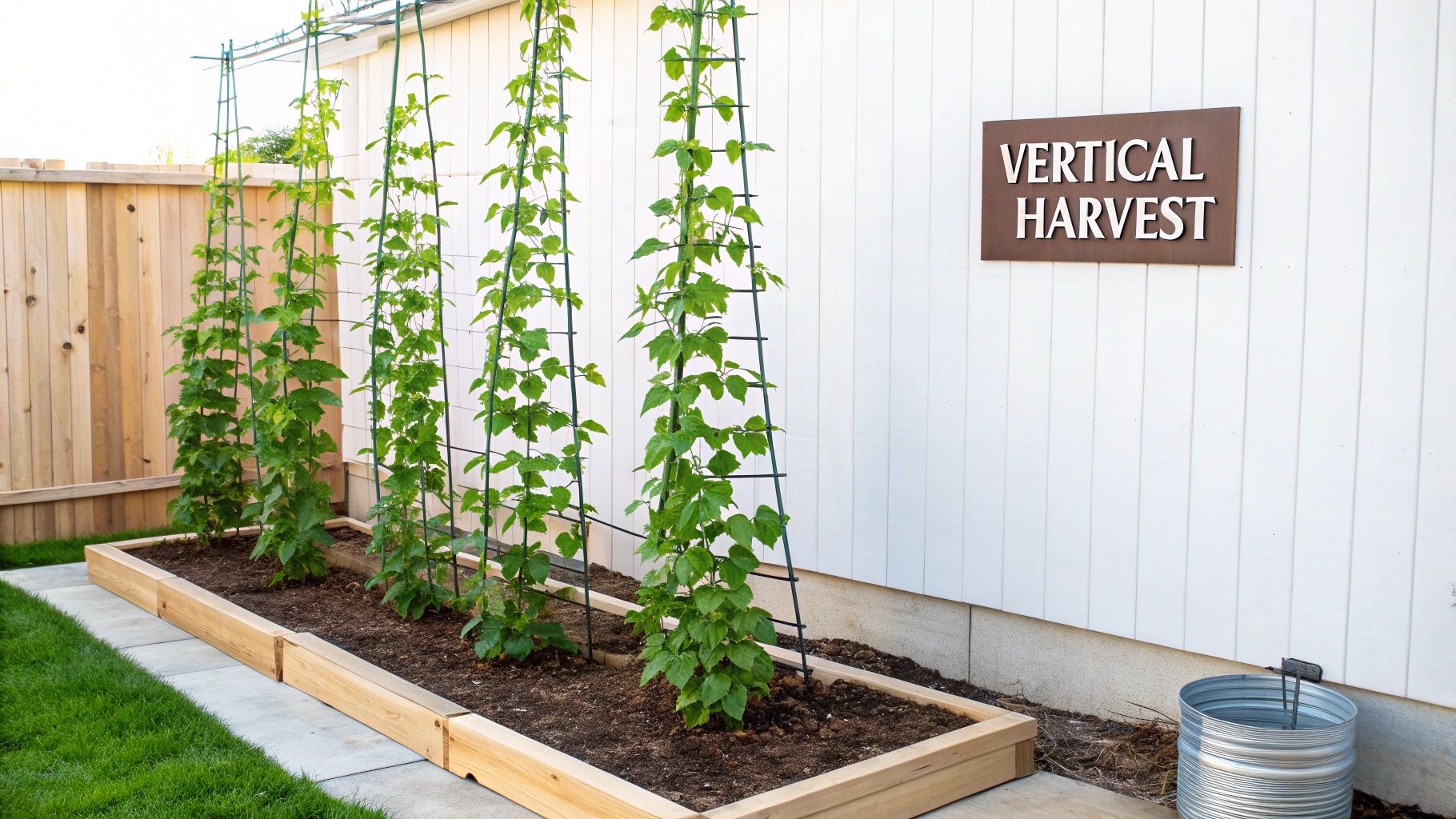
Picture this: a small patch of soil in your yard transformed into a living green tower, loaded with crisp, delicious beans ready for picking all summer. That's the real magic of growing pole beans. Think of this guide as your complete roadmap—we're going beyond the basic instructions to share practical, experience-based advice that will lead to an incredible harvest.
For my money, pole beans are one of the most satisfying vegetables a home gardener can grow. They're ridiculously productive, often yielding two to three times more than bush beans in the same footprint. Because they grow up instead of out, they're a perfect fit for small gardens, patios, or anyone trying to maximize their growing space.
Why Choose Pole Beans
There are some fantastic reasons to make room for these climbers in your garden plan, and they go well beyond just saving space.
- Season-Long Harvest: Bush beans give you one big crop and then they're done. Pole beans, on the other hand, will keep pumping out pods for a month or longer, provided you keep up with picking.
- A Back-Saver: Harvesting is just plain easier. The beans hang at a comfortable height, which means a lot less bending and kneeling.
- Healthier Plants: Growing vertically creates much better air circulation around the leaves. This simple fact goes a long way in preventing common fungal diseases that can plague other garden plants.
- Superior Flavor: Many long-time gardeners (myself included) will tell you that pole beans simply have a richer, more authentic "beany" flavor. Plus, the world of heirloom varieties opens up a ton of unique colors and tastes you'll never find in a grocery store.
The real secret to a massive harvest is consistency. Every time you pick a bean, you're sending a signal to the plant to make more. A little attention each day turns a few vines into a season-long supply.
In this guide, we'll walk through everything. We’ll cover choosing the best varieties for your climate and building simple trellises strong enough to hold up a heavy, productive crop. You'll learn the tricks for preparing the perfect soil, getting your planting time just right, and knowing the peak moment to pick for the best possible flavor. Let's get you ready to grow pole beans like you've been doing it for years.
Choosing the Best Pole Bean Varieties
The secret to an amazing pole bean harvest starts way before you even think about getting your hands dirty. It all begins with picking the right seed. With so many options out there, it’s easy to feel a bit lost. So, let's talk about some of the most reliable and delicious varieties I've come across that are perfect for a home garden.
Each one has its own personality—some are workhorses, others are gourmet showstoppers. It really comes down to what you like to eat and how you plan to use them in the kitchen.
Classic All-Around Performers
You just can't go wrong with a classic. These are the beans that have earned their reputation for a reason: they're incredibly productive and have that rich, satisfying bean flavor you're looking for. They're perfect for just about anything.
-
Kentucky Wonder: For many folks, this is the quintessential pole bean. It's a classic American heirloom that’s been around since the 1850s. Known for being a powerhouse producer, you'll get clusters of 6-8 inch, meaty pods. The flavor is exactly what you expect from a great bean, making it an ideal all-purpose choice for fresh eating, freezing, or canning.
-
Rattlesnake: Don't let the name scare you! This heirloom is a real head-turner in the garden, with beautiful green pods streaked in deep purple. The purple color does fade when you cook them, but what’s left is a tender, incredibly flavorful bean. A huge bonus is that 'Rattlesnake' is known for being remarkably drought-tolerant, so it’s a tough, resilient option if you live somewhere with hot, dry summers.
Gourmet and Stringless Varieties
If you’re after something a little more refined, or if you just can't stand the thought of de-stringing beans, these gourmet picks are for you. They have unique qualities that really set them apart.
The word "stringless" is a lifesaver. It simply means that tough, fibrous string along the pod’s seam has been bred out. The whole bean is tender and ready to eat without any extra fuss.
-
Fortex: If you dream of growing those incredibly long, slender beans, ‘Fortex’ is your winner. These French filet-style beans can easily reach 11 inches or more and somehow stay perfectly crisp and stringless. They're a personal favorite of mine for steaming or sautéing whole; their delicate texture is just fantastic. Plus, their productivity is off the charts—they’ll often keep producing right up until the first frost.
-
Trionfo Violetto: Looking to add some drama to your garden? This Italian heirloom is the answer. It grows stunning, deep-purple pods that are as delicious as they are beautiful. Just like 'Rattlesnake,' the purple color vanishes with heat, revealing a bright green bean underneath. People rave about its wonderful flavor, and it's a great way to add a pop of color to your trellis.
Before we move on, here’s a quick way to compare these fantastic options at a glance.
A Quick Look at Top Pole Bean Varieties
Use this table to quickly compare these popular pole bean types and find the perfect match for your garden goals.
| Variety Name | Key Feature | Days to Maturity | Best For |
|---|---|---|---|
| Kentucky Wonder | Classic, meaty, all-purpose | 65-75 days | Canning, freezing, and fresh eating |
| Rattlesnake | Purple-streaked, drought-tolerant | 60-90 days | Hot climates and shelling |
| Fortex | Extra-long, stringless, gourmet filet | 60 days | Steaming, sautéing, and fresh eating |
| Trionfo Violetto | Striking purple pods, great flavor | 60 days | Adding visual appeal and fresh eating |
Honestly, you can't go wrong with any of these. The real trick is matching the bean’s traits to your climate and what you’re hoping to pile on your dinner plate. Whether you want a dependable classic or a showy gourmet bean, there's a perfect variety just waiting to climb up a trellis in your garden.
Getting the Ground Ready for Great Beans
Great pole beans don't just happen—they start with the ground they're planted in. If you do one thing right this season, make it getting the soil in top shape. It’s the single best investment you can make for a heavy harvest.
First things first, find your sunniest spot. Pole beans are sun-worshippers and need a solid 6 to 8 hours of direct sunlight every day to really get going and produce a ton of pods. Less sun means a much smaller harvest, so this part is non-negotiable.
Once you've picked your location, turn your attention to the soil itself. The ideal home for pole bean roots is loose, well-draining soil that they can easily push through. If you’re dealing with compacted, heavy clay or fast-draining sandy soil, you'll want to add some organic matter to improve the texture.
- Compost: This is the gardener's secret weapon. It improves just about everything, adding nutrients, improving drainage in clay, and helping sand hold onto moisture.
- Aged Manure: Another fantastic choice, well-rotted manure gives your plants a great nitrogen boost for lush, green growth.
A Quick Soil Chemistry Check
It’s not just about texture; soil chemistry matters, too. Pole beans are happiest in soil that's slightly acidic to neutral—aim for a pH between 6.0 and 7.0. You can easily check this with a simple soil test kit from any garden center.
If your test shows the soil is too acidic (pH below 6.0), a little garden lime will bring it up. If it’s too alkaline (pH above 7.0), you can lower it by mixing in some elemental sulfur or peat moss. Getting the pH right is like unlocking a pantry door; it allows your plants to access all the nutrients waiting for them in the soil. For a deeper dive, our guide on preparing garden soil for planting has all the details.
Remember, healthy soil isn't just dirt—it's a thriving ecosystem. When you add compost, you're feeding the billions of tiny microbes that work to make nutrients available for your bean plants.
This focus on soil health isn't just a backyard practice; it's what drives success on a massive scale. In 2023 alone, fresh market green bean sales in the U.S. topped $241.7 million. That kind of production hinges on perfect cultivation practices, starting with the soil. Taking the time to get this right at the beginning is what will set your garden up for an amazing harvest.
Building a Trellis That Actually Works
Pole beans are climbers by nature; their whole mission is to head for the sky. Giving them a solid support system isn't just a nice-to-have—it's absolutely critical if you want a bumper crop. You can forget about those flimsy little cages from the big-box store that buckle under the weight of a few healthy vines. We're going to talk about simple, sturdy structures you can build yourself that will hold up all season long.
A well-designed trellis does more than just prevent your plants from flopping over. It allows for much better air circulation, which is your best friend in preventing common fungal diseases like powdery mildew. It also gets the beans up off the dirt, keeping them clean and making them way easier to see when it's time to harvest. A good structure is a cornerstone of your pole bean growing strategy.
Think of it this way: your beans need the right fuel from the ground up to have the energy to climb the structure you provide.
Getting the fundamentals right—plenty of sun, good compost, and the right nutrients—is what sets the stage for vigorous vertical growth.
DIY Trellis Designs for Any Garden
You don't have to be a master carpenter to put together a trellis that your beans will love. Here are a couple of tried-and-true designs that are easy to build and work like a charm.
-
The Classic Bamboo Teepee: This is probably the simplest and most elegant solution out there. All you need are 3-5 bamboo poles (make sure they’re at least 6-7 feet tall) and a bit of sturdy garden twine. Just shove the poles into the ground to form a circle, then lash them together tightly at the top. It's surprisingly strong and looks fantastic as a vertical element in any garden bed.
-
The A-Frame Trellis: If you want to maximize your growing space, the A-frame is a great option, perfect for a double row of beans. You basically build two simple rectangular frames out of wood or bamboo, connect them at the top with a hinge or a solid crosspiece, and spread them out to form a stable "A." Then, you can run twine vertically or stretch netting across the frame for the beans to grab onto. For more ideas like this, check out our guide on https://homegrown-garden.com/blogs/blog/small-space-big-garden-vertical-gardening-ideas-for-spring.
A strong trellis is a long-term investment. Using durable materials like cattle panels or treated lumber means you can reuse the same support system for years, saving you time and money each season.
If you’re building something more permanent, like a cattle panel arch between two posts, it pays to do it right. Learning the proper technique for cementing fence posts for a sturdy base will ensure your structure stands strong against wind and the weight of a heavy harvest for years to come.
While we're just picking for our kitchens, it's amazing to think about the scale this can reach. In 2019, China produced an astounding 21 million tonnes of green beans—that’s roughly 75% of the entire world's supply! This just goes to show how effective well-supported, hand-harvested crops can be on a massive scale.
Bringing in Your Bean Harvest
With your trellis built and the soil prepped, you're ready for the best part: planting. But don't jump the gun. Timing is absolutely crucial for pole beans. You need to wait until the last chance of frost is long gone and the soil has warmed up to at least 60°F (15°C). Planting seeds in cold, wet ground is just asking for them to rot before they even get a chance to sprout.
When the time is right, plant your seeds about one inch deep right at the base of your support structure. If you’re using a teepee, I like to plant 4 to 6 seeds around each pole. For a flat trellis, spacing them every 4 to 6 inches works perfectly. You don't have to be exact—once they pop up, you can easily thin them out, leaving only the strongest-looking seedlings.
How to Get More Beans Than You Can Handle
Want a steady stream of beans all summer instead of one giant harvest? The trick is succession planting. It's simple: just sow a new little batch of seeds every two or three weeks. This staggers their maturity and keeps fresh beans coming to your kitchen for months. Nailing the timing for your specific climate is a bit of an art, and you can learn more about it by exploring when to plant vegetable seeds in our detailed guide.
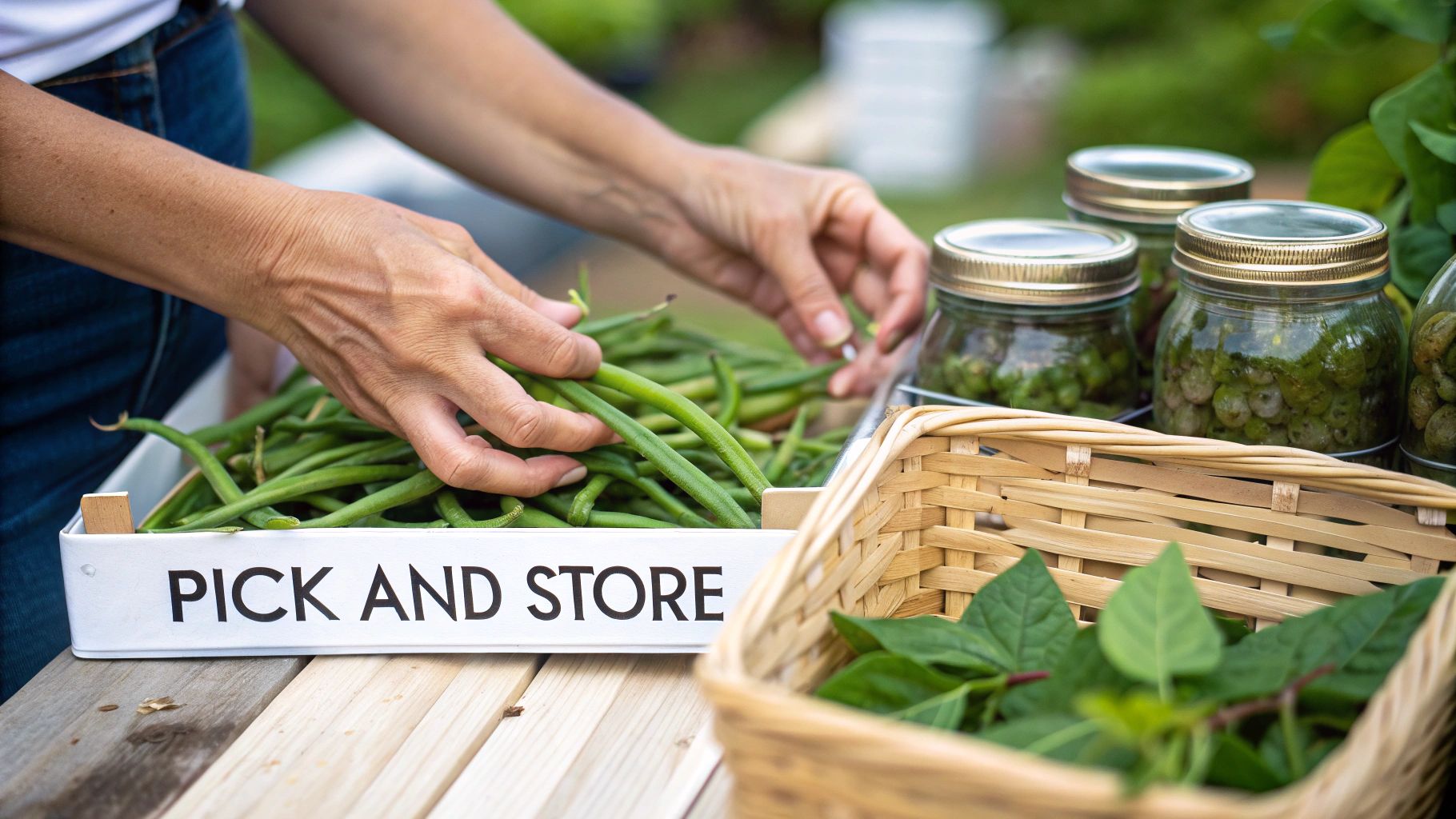
Once the beans start coming in, your number one job is to pick them. And pick them often. Harvesting every 2 to 3 days sends a message to the plant: "Keep going!" The more you pick, the more flowers the plant will produce, and that means more beans. If you let the pods get old and lumpy on the vine, the plant figures its work is done for the season and will shut down production.
So, how can you tell when a bean is at its peak?
- Firm and Crisp: A good bean will feel firm, never flimsy or soft.
- Smooth Pods: You want to pick them before the seeds inside swell and create obvious bumps along the pod. For most types, that's when they're about as thick as a pencil.
- The Snap Test: This is the classic test for a reason. A perfect bean should snap cleanly in two with a satisfying crunch.
Harvesting quickly becomes a rewarding daily ritual. The simple act of picking encourages the plant to give you even more. This continuous production is the real magic of growing pole beans—it’s amazing how a few plants can turn into a non-stop food factory.
Storing the Bounty for Later
Let's be honest, you're going to have more beans than you can possibly eat fresh. That's a great problem to have, and luckily, they're a breeze to store.
For beans you plan to eat within the week, just pop the unwashed pods into a plastic bag in your fridge's crisper drawer. They’ll stay nice and crisp.
When it comes to long-term storage, freezing is the way to go. Just blanch them for two minutes in boiling water, then immediately shock them in a bowl of ice water to lock in that vibrant green color. Pat them dry and freeze them in airtight bags or containers. This process keeps their fantastic flavor and texture for months, giving you a taste of summer on a cold winter day. The value of a good harvest isn't just for home gardeners; in 2023, Morocco exported an impressive 108,800 tonnes of green beans, showing just how productive this crop can be.
Common Questions About Growing Pole Beans
Even the most carefully planned garden has a way of throwing you a curveball. When it comes to pole beans, a few common questions pop up time and time again. Let’s walk through some of the most frequent hiccups and how to get your vines back on track.
Why Are My Bean Plants All Leaves and No Flowers?
Ah, the classic "all vine, no beans" dilemma. It's frustrating to see gorgeous, lush green plants that refuse to flower. Almost every time, the culprit is too much nitrogen.
Nitrogen is what fuels green, leafy growth. If your soil is too rich in it—often from using a lawn fertilizer or a compost heavy in "greens"—the plant gets a signal to just keep making leaves. It never feels the need to switch gears and produce flowers for the next generation.
The fix is to cut off the nitrogen supply. Stop using any high-nitrogen fertilizer immediately. Instead, you can give your plants a little nudge with a fertilizer that's higher in phosphorus and potassium (the "P" and "K" in N-P-K). Also, take another look at your sunlight. Bean plants need 6-8 hours of direct sun to really get going; if a nearby tree has leafed out and is casting more shade than you realized, that could be the problem right there.
What’s Causing Yellowing Leaves on My Plants?
Yellow leaves (chlorosis) are a plant's way of telling you something is wrong, and usually, it's a water issue. Both overwatering and underwatering can cause leaves to turn yellow. Soggy soil suffocates the roots, while bone-dry soil sends the whole plant into stress mode.
Your goal isn't to water on a strict schedule but to keep the soil consistently moist, like a well-wrung-out sponge.
- Do the finger test. The best way to know for sure is to stick your finger an inch or two into the soil near the plant's base. If it comes out dry, it's time for a good, deep soak. If it's still damp, hold off.
- Check for pests. If the watering seems right, flip a few leaves over and look closely at the undersides. Fine, silky webbing is a dead giveaway for spider mites, which literally suck the life out of leaves, causing them to yellow.
- Could it be a nutrient deficiency? If you notice the yellowing is starting with the oldest, lowest leaves on the plant and moving up, it might just need a little food. This pattern often points to a simple nitrogen deficiency, which a quick dose of a balanced liquid fertilizer can usually correct.
It's so much better to water deeply once or twice a week than to give your plants a shallow sprinkle every day. Deep watering encourages the roots to grow down into the soil, creating a stronger, more drought-resistant plant.
Can I Grow Pole Beans in a Container?
You absolutely can! In fact, pole beans are a fantastic choice for container gardening. Their vertical habit is a huge space-saver, letting you grow a ton of food in a small footprint.
Success comes down to the size of your pot. You need something big enough to support a vigorous, thirsty plant all season long. I'd recommend a container that's at least 5 gallons in volume and 12-15 inches deep. This gives the roots plenty of room to spread out. And, of course, make sure it has excellent drainage holes—beans will not tolerate "wet feet." You'll also need to stick your trellis, like a simple bamboo teepee, right into the pot for the vines to climb.
Just remember, containers dry out way faster than garden beds. In the heat of summer, you'll likely need to water every single day, so stay vigilant.
How Often Should I Pick My Pole Beans?
The short, simple answer? All the time!
Once your beans start coming in, the best thing you can do to keep the harvest going is to pick them constantly. Make a habit of checking your vines and harvesting every 2-3 days.
Picking the pods sends a message to the plant that its work isn't done yet, triggering it to produce more flowers and, consequently, more beans. If you leave mature pods on the vine, the plant thinks it has successfully made its seeds and will shut down production.
For the best flavor and texture, harvest your beans when they are still slender and crisp, before the seeds inside start to bulge. This not only keeps the plant productive but ensures every bean you pick is at its absolute peak. Beyond these specifics, great gardening often comes down to a handful of core principles. You can discover some of these in these 10 crucial gardening tips to help your entire garden thrive.
Ready to start your own vertical harvest? At Homegrown Garden, we have everything you need, from heirloom pole bean seeds to beginner-friendly gardening kits. Explore our collection and get all the tools and support for a successful growing season at https://www.homegrown-garden.com.


